Outlook Calendar
Use Outlook Calendar to discover calendars, read a time window, search or inspect events, and create or revise appointments.
Before you start
Section titled “Before you start”Open Customize → Plugins and select this plugin. Add installs an available package; Uninstall means it is already installed. An offered Update refreshes its package version. Your deployment and administrator policy determine availability.
When Add Account is offered, follow its connection instructions using an authorized account that owns or can access the intended resource. If several accounts are connected, check the selected account and Default before the task. Reconnect refreshes an expired connection; an administrator setup notice needs administrator configuration.
Enable the plugin for the selected agent or task. On an installed plugin’s Tools table, check Enabled and the Approval setting for the operations you intend to use. New tasks use these settings; a pending approval still needs a decision. See agent setup and action approvals.
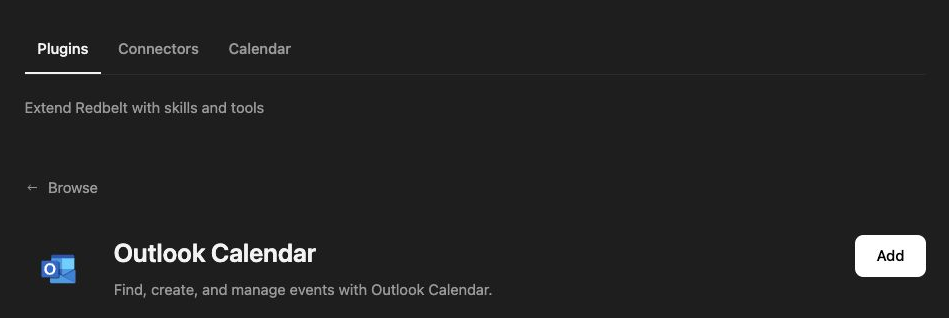
Plugin details under Customize → Plugins. The button shows the current installation state.
Schedule a launch review
Section titled “Schedule a launch review”- Ask Redbelt to list calendars and select the intended calendar ID.
- Read the calendar view for the date, time window, and time zone you want to use.
- Prepare the event with your chosen title and that exact start, end, and time zone. Add attendees only if you intend to invite them.
- Review the destination and details before requesting creation.
- Read the returned event ID and confirm its saved time, attendees, and content.
List my Outlook calendars and ask me which one to use. Ask me for the date, start and end times, and time zone for a Project Review, then check for conflicts. Prepare the event with no attendees and show me the details before creating it.
Find and revise an event
Section titled “Find and revise an event”Use the calendar view for a defined time range, event listing for a calendar’s items, and search for a text match. Read a single event before changing it. An event’s ID is more reliable than repeating a potentially ambiguous title search.
Updates should include only the intended changes. If you reschedule, explicitly provide the date, time zone, and end time. Invitations and updates to attendees can have effects outside Redbelt, so review the attendee list before the action.
Deletion is available for selected events. Confirm the event and calendar first, then inspect the result. If the goal is a time change, update the existing event rather than deleting and recreating it.
Tool Reference
Section titled “Tool Reference”Thread and workflow availability are listed separately. A tool must also be enabled for your task and allowed by its account and administrator policy. Configure workflow app actions using only actions offered by the current picker.
Available Tools
Section titled “Available Tools”| Tool | Required Fields | Thread | Workflow |
|---|---|---|---|
microsoft_calendar.create_event |
subject, start_datetime, end_datetime |
Yes | Yes |
microsoft_calendar.delete_event |
event_id |
Yes | No |
microsoft_calendar.get_event |
event_id |
Yes | No |
microsoft_calendar.get_view |
No mandatory top-level fields | Yes | Yes |
microsoft_calendar.list_calendars |
No mandatory top-level fields | Yes | No |
microsoft_calendar.list_events |
No mandatory top-level fields | Yes | Yes |
microsoft_calendar.search_events |
query_text |
Yes | Yes |
microsoft_calendar.update_event |
event_id |
Yes | No |
Required fields above are the schema minimum. The target, selected operation, or account can impose additional requirements.
microsoft_calendar.create_event — Create a new calendar event.
Optional fields: attendees, body, calendar_id, is_online_meeting, location, timezone.
microsoft_calendar.delete_event — Delete a calendar event.
Optional fields: calendar_id.
microsoft_calendar.get_event — Get details of a specific calendar event.
Optional fields: calendar_id, timezone.
microsoft_calendar.get_view — Get calendar view for a time range (expands recurring events).
Optional fields: calendar_id, end_datetime, max_results, relative_date_range, start_datetime, timezone.
microsoft_calendar.list_calendars — List all accessible calendars.
microsoft_calendar.list_events — List upcoming calendar events.
Optional fields: calendar_id, end_datetime, max_results, relative_date_range, start_datetime, timezone.
microsoft_calendar.search_events — Search across calendar events.
Optional fields: max_results, relative_date_range, subject, timezone.
microsoft_calendar.update_event — Update an existing calendar event.
Optional fields: attendees, body, calendar_id, end_datetime, location, start_datetime, subject, timezone.
Troubleshoot
Section titled “Troubleshoot”For unexpected times, compare the returned time zone and start/end values. For not-found errors, check the selected calendar and current event ID.
Provider details: Outlook Calendar documentation.